 Sahityika Admin
From Rubble to Resolve:
An Indian Delegate’s Experience in Post-Taliban Afghanistan
© Amitava Datta, 1974 Civil Engineering
In August 2002, I was one of twelve delegates selected by the CDC (Consultancy Development Centre), Government of India, to Kabul, Afghanistan, in the aftermath of Taliban regime’s fall. Our delegation comprised consulting specialists from diverse cross sections of the Indian industry: Infrastructure (including myself), Builders, Manufacturing Industries, Property Developers, and Traders. The Government of India, in coordination with the Indian High Commission in Kabul, arranged our visas, security, accommodation, and local transport.
We departed from Delhi International Airport in the early morning aboard an Ariana Afghan Airlines flight, which would carry us across a landscape still marked by conflict and reconstruction.
Day 1: Arrival and First Impressions:
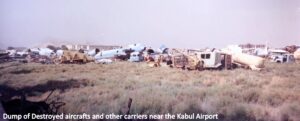
We landed at the Kabul International Airport, where the visible signs of war were stark even from the air: the tattered remains of aircraft and derelict airframes scattered near the runway bore witness to the recent conflict. There was no mechanized luggage handling; all bags were unloaded manually, and the airport staff extended a courteous, almost reverent deference to us as Indian nationals. Immigration formalities were entirely manual that ficers recorded passport details by hand, with no computer terminals or electronic scanners in sight. I recall feeling simultaneously humbled and unnerved by the rudimentary procedures in stark contrast to the modern facilities we were accustomed to.
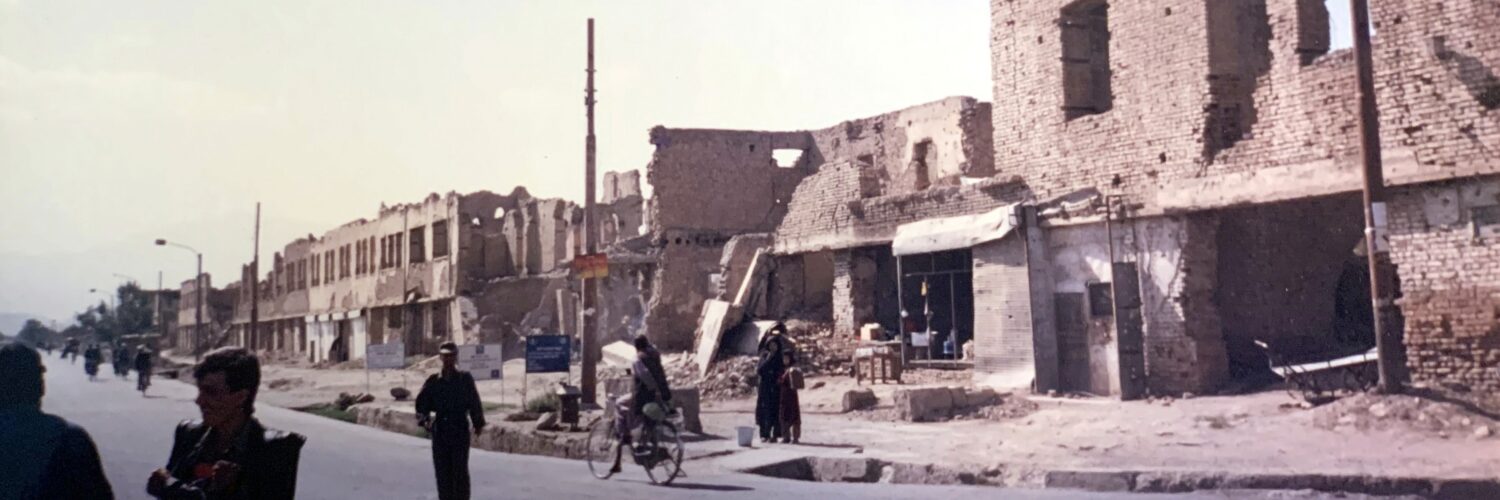
Once through with immigration, we boarded our pre-arranged Land Cruisers (by Indian High Commission). Kabul’s streets were lined with battered buildings; many structures were half-ruined, their façades pockmarked by either shellfire or collapsed entirely.
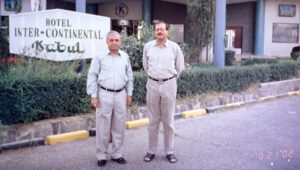
Our destination was the Intercontinental Hotel, one of Kabul’s few large-scale establishments. However, “hotel” was a generous term: of its 200 rooms, only 60 to 65 had been made minimally habitable. During the civil war, the hotel suffered extensive damage due to street fighting between rival militias. Most rooms and other service zones were destroyed by rockets and shell fires. Despite its condition, this hotel was extensively used by Western journalists during the U.S. invasion of Afghanistan in 2001, as it was the only large hotel still operating in the capital at the time. In 2002, the hotel’s pool became dry, and the gym was stripped of all its furniture. Power outages were frequent throughout the day, and bullet holes were still visible across the building, including in the windows of the first-floor restaurant. There was no functioning air conditioning, water supply was intermittent, and only two of the multiple elevators remained operable. The kitchen facilities were in shambles; incapable of preparing lunch or dinner—so the hotel served breakfast only, which came at a cost and was not included in our room rate. Despite these challenges, the Intercontinental provided a symbolic foothold of normalcy amid devastation.
Days 2 to 4: Meetings and Observations:
Our schedule began the following morning with meetings with the Ministry of Industries. We were received by senior ministry officials and we presented our credentials. Although their offices were functional, they too bore the scars of conflict: missing ceiling tiles, cracked windows, and battered wooden furniture. Our meeting with the Ministry of Industries focused on the rebuilding local manufacturing capacity, particularly small- to medium-scale enterprises that had collapsed under Taliban-era restrictions. We emphasized the need for the basics of technical guidance, capacity-building workshops, and the importance of establishing reliable power and water supplies to revive the industrial sector. Afghan officials expressed optimism but repeatedly stressed their challenges: security concerns, lack of foreign investment, and the absence of a stable banking infrastructure.
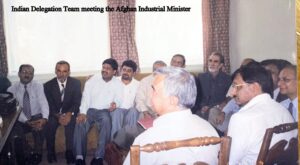
Later that same day, we met the Minister of Urban Development. Seated behind a large, scarred desk piled high with paperwork, the Minister outlined the enormity of Kabul’s reconstruction needs: clearing land mines from residential neighbourhoods, repairing water supply networks, and rebuilding roads that had been reduced to rubble. He spoke of the Afghan Capital Development Authority (ACDA) initiatives, which was aimed to reconstruct essential civic infrastructure. The discussions were on immediate restoration of water supply, sanitation, electricity, roads, bridges, hoping Indian expertise could assist in rebuilding. Minister noted that while donor interest existed, coordination was minimal, and Afghan technical capacity had been decimated.
On Day 3, our delegation visited the Afghanistan Chambers of Commerce and Industry (ACCI).
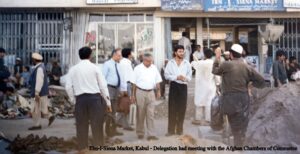
The ACCI office had been hastily reassembled in a bomb-damaged building; a lone generator provided erratic power, and the telephone lines were often dead. We met with chamber representatives who detailed challenges facing traders: no formal banking system meant every transaction was conducted in cash.
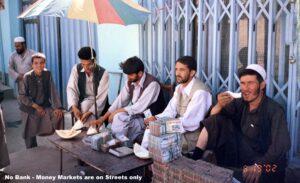
Even changing 25 USD into Afghani required hours spent at unofficial money changers on dusty roadside stalls. The exchange rate was so unfavourable that you need a briefcase rather than purses to carry enough Afghani for routine expenses. Our ACCI hosts lamented the absence of certified banking institutions, which hampered their import–export activities.
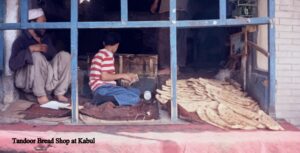
On Day 4, we finished our few pending meetings and returned to the hotel little early. Back at the hotel, we discovered that around ten crew members from FOX TV were also staying there, highlighting how international media had begun flocking to Afghanistan to cover its rebirth. Yet, the hotel’s deficiencies were ever-present: dinners were impossible, so every evening our small groups ventured out to nearby eateries—mostly family-run restaurants serving simple kebabs, rice dishes, and flatbreads baked in tandoor ovens. I vividly recall buying clusters of freshly made roti from a street vendor whose clay oven stood amidst mounds of lentils and flour sacks. Each loaf cost barely a few Afghanis, and locals queued eagerly, tucking dozens of Tandoor Rotis under their arms to bring home.
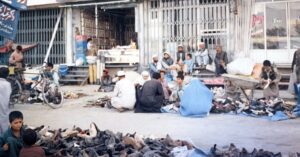
Fruit vendors lined the sidewalks, selling watermelons by the slice. The melons were succulent—perhaps one of the few luxuries still available amid a society struggling with basics. Even torned discared shoes, used in the civil war, are sold on streets. It struck me how the simplest pleasures took on profound importance when more complex systems—electricity, plumbing, banking had collapsed.
At night, the hotel’s lone working elevator served as our silent witness to weary delegates, all of us clutching bags of Afghani cash, navigating dimly lit corridors to return after dinner. In one dark corner of the lobby, an elderly Afghan ushered delegates to their rooms, his face weathered, his eyes reflecting a mixture of hope that the world had not forgotten Kabul and sadness at the destruction surrounding him.
Day 5: City Tour and Reflections:
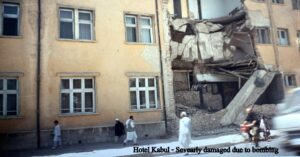
On our final day, local guides arranged our city tour. We passed by Hotel Kabul, once a regal edifice overlooking the city; now it’s grandeur was replaced by shattered windows and collapsed balconies. The elite Kabul Club, a bygone symbol of social life, had been reduced to a crater-like shell. Its swimming pool, once a glamorous centrepiece, became a dumping ground strewn with garbage. Locals whispered that the Taliban had used the diving board as some execution gallows, hanging victims and dumping their bodies into the pool below. This grim detail underscored how deeply the conflict had penetrated everyday spaces.
Military Personnel:
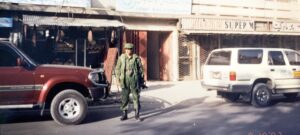
Afghan militia and international peacekeepers manned every major intersection. Checkpoints, makeshift sandbag barricades, and razor wire had become fixtures of city life. Despite this, many Kabul residents emerged midday to sell produce, run bakeries, and conduct small trades. We saw a small tandoor bakery where men in turbans shaped dough into flat discs and slapped them against the oven walls; the aroma of fresh bread mingled with dust and engine oil. Children, curious and unassuming, watched our convoy pass, waving energetically. Curiously, Afghan people greeted us as Indians with warmth and respect; several shopkeepers and passers-by called out “Namaste” or “India” as a gesture of goodwill. We learned that throughout the conflict, India had provided significant humanitarian assistance of medical aids, food supplies, and scholarships for Afghan students—so the Indian delegation was often treated as emissaries of friendship.
As we re-entered the airport on our departure day, the same scene greeted us: battered aircraft carcasses, dust-choked taxiways, and manual luggage handling. Yet, the airport staff greeted us cheerfully, almost as old friends. Though we did not linger, each of us felt a profound mixture of sorrow—mourning the city’s shattered infrastructure and scarred populace—and exhilaration at witnessing the first tentative steps toward reconstruction.
Conclusion:
Our five-day delegation visits to Kabul in August 2002 offered far more than a professional survey of infrastructure and investment potential—it was a window into the soul of a wounded nation struggling to stand tall again. The absence of basic civic systems like banking, healthcare, electricity, sanitation, etc. revealed the sheer scale of devastation. Yet, amid this bleak backdrop, what shone through most clearly was the unbroken spirit of the Afghan people.
We witnessed resilience in the simplest of acts: in bakers rising early to feed their neighbourhoods, children waving with innocent curiosity, and ministry officials speaking of the future with unwavering conviction. Their eyes reflected pain but also hope. As an infrastructure consultant, I realized that while technical solutions like modular housing, solar power, and decentralized sanitation systems were crucial, what Afghanistan needed most was sustained solidarity and trust.
India had already extended a hand through humanitarian aids, scholarships, and diplomatic support, and our visit reinforced the importance of continuing that partnership. The groundwork we laid through dialogues with the Ministries of Industries and Urban Development and the Afghanistan Chambers of Commerce and Industry could one day mature into meaningful collaborations. But more than blueprints and feasibility reports, this journey reminded us that rebuilding a city, and a nation is not only about bricks and mortar. It is about restoring dignity, normalcy, and belief in a better tomorrow.
As our plane lifted off from the bullet-ridden tarmac of Kabul International Airport, I looked out over the sprawling, dust-cloaked city—scarred, but stirring with life. I left with a heart full of memories, a mind enriched with insights, and a renewed conviction that, with compassion and cooperation, even cities reduced to rubble can find their resolve—and rise again.
*******





My touch with your Sahityika is limited to English only. I liked this article on Afghanistan, some portions are beautiful texted. Asim’s selection of news are interesting. So as Shruti’s poem.