

 Sahityika Admin
News Around:
Compiled By: Asim Deb, 1977 Electronics & Tele-Communication Engineering.
The woman who keeps flying into disaster: Nepal pilot’s 100 rescue missions in six days
Captain Priya Adhikari, Nepal’s first woman helicopter captain, has flown into remote flood-hit areas where landslides and destroyed roads have left communities stranded.

In the aftermath of Nepal’s devastating floods and landslides, there are several unsung heroes. For example, in Nuwakot, Rajendra Dawadi, the Principal of Tribhuvan Trishuli Secondary School, helped around 900 students by evacuating them within minutes as floodwaters came rushing in. But among them, Captain Priya Adhikari stands out for another reason. Nepal’s first woman helicopter captain, Adhikari has flown about 100 rescue missions in just six days, in some of the most difficult terrain along the Nepal-Tibet border. In places roads and bridges had been destroyed, while unstable slopes, landslides, debris and unpredictable weather made ground access extremely difficult. Then helicopter became the lifeline, and she did high-altitude search-and-rescue operations in the Himalayas.
Her journey to the cockpit began almost by accident.
She was studying for a degree in environmental science and working as cabin crew with a domestic airline when friends casually asked her to join a helicopter crew on a regular flight. It was a cold winter morning. She stepped into the helicopter not knowing that the experience would change the direction of her life. With the support of her parents, Adhikari travelled to the Philippines about 11 years ago to undergo flight training. She returned to Nepal and eventually became a full-time helicopter pilot in 2017. The road was not easy. First, it was a profession overwhelmingly associated with men. Second, the pilots have to contend with narrow valleys, rapidly changing weather and limited landing areas. Search-and-rescue missions add another layer of pressure because the objective is not just to fly safely, but to reach people whose lives may depend on every passing minute.

Over the years, she has participated in missions to rescue injured mountaineers in the Himalayas, including operations around Mount Everest. She was also a lifeline after Nepal’s devastating earthquake. But for the recent flood, the scale of destruction meant that helicopters were being used across isolated areas. Crews also had to reach locations where people had died and retrieve bodies from areas that could no longer be accessed by road. Becoming Nepal’s first woman helicopter captain has therefore been both a personal achievement and a quiet challenge to that convention.
Today, as Nepal confronts another major disaster, Adhikari is once again in the air.
*********
The 20-year-old BSc student from Madhya Pradesh, Surendra Singh Choudhary, popularly known as ‘Bittu Tabahi’, has drawn attention for taking a task and successfully cleaning the polluted Ajnar River in Biaora on his own. His efforts have now reached audiences outside India after a Netherlands-based organisation gave him an offer to work with them. He started the cleanup on January 26, 2026, the Republic Day, and worked by himself until the local municipal corporation noticed his efforts and stepped in to help. Instead of waiting for authorities or an organised clean-up drive, Bittu has been carrying out the work himself and spending his own money on the supplies needed for the clean-up.

The boy first came into the spotlight after online posting of before-and-after images and videos of the river. The footage revealed alarming conditions, with large quantities of plastic waste, bottles, algae, discarded materials and religious offerings choking the water… choking the waterway. In several areas, the river was barely visible beneath layers of accumulated garbage. Working with minimal resources, the boy relied largely on manual labour instead of machinery. Armed with basic cleaning tools, he entered the polluted water himself, pulling out waste and clearing blocked sections of the riverbank to restore water flow. He also adopted a sustainable approach by collecting discarded religious offerings and converting them into compost rather than allowing them to return to the river. Reports says that he and a small group of friends initially contributed their own money to purchase cleaning equipment and install dustbins around the area. Over time, he is believed to have spent nearly Rs 30,000 on the initiative.
Prolonged exposure to polluted water also led to skin irritation and infections. Despite the setbacks, he continued the clean-up campaign for months.
Boyan Slat, founder and CEO of The Ocean Cleanup, recently invited this 20-year-old Surendra Singh Choudhary (Bittu Tabahi), to join his organisation after videos of his river restoration efforts went viral. The invitation came after months of work by Bittu. Responding to a post about the student’s work, Slat wrote, “Come work for us @Surendr75950620,” a remark that quickly attracted attention across social media and brought global recognition to the young environmental activist.
** Founded in 2013, The Ocean Cleanup is a non-profit organisation that develops technologies to remove plastic pollution from oceans and rivers around the world.
*********
Tukaram Mundhe, the Maharashtra Food Commissioner, carried food inspections, suspends 300+ licences, and 1,000+ issued caution notices.
Cockroaches scurry across kitchen floors. Spider webs cling to walls. Spoiled vegetables rot in corners, while food counters show signs of pest infestation. Dozens of photos and videos have gone viral since May, after Maharashtra’s Food and Drug Administration (FDA) began a series of inspections at restaurants, cafes and other food businesses across the state. At the centre of this crackdown is 51-year-old civil servant Tukaram Mundhe, the state’s new Food Commissioner.

When compared with the data in the year 2025-26, the last three months have seen a 557% increase in the number of complaints received, 378% increase in investigation of complaints, and a 217% increase in the number of searches and seizures. The earlier five-year period had an average of approximately 1,463 inspections per month (87,807 inspections in 60 months). However, the June-August of 2026 period recorded an average of 967 inspections per month (2,902 inspections in three months).
“These actions are taken in public health interest. We will continue to take them against violations,” Mundhe told the BBC. The campaign has made Mundhe a recognisable face across India, rare for a civil servant. By the end of July, his department had carried out more than 3,100 inspections across the state, & around 300 licences had been suspended and more than 1,000 improvement notices issued. Consumers have responded positively to that visibility, and the campaign has also made Mundhe a social media star – he now has more than 3.8 million followers on Instagram.
However, the restaurant associations allege the official has been bypassing a statutory process, and courts have termed some of his actions “high-handed”. In August, for instance, the Bombay high court ordered Mundhe’s department to pay 500,000 rupees in compensation to a sweet shop whose licence remained suspended even after a reinspection found it 98% compliant with the law. Within a day, Mundhe’s team inspected canteens in the state’s high court complex and flagged violations.
“We are not here to close down or suspend every licensee,” he said. “We are here to ensure food is safe, food is not substandard, it is not misbranded and it is good for consumption.” Mundhe has also enforced bans on using newspapers to wrap food, synthetic dyes and banned analogue paneer – non-dairy cottage cheese substitutes. Its focus has now shifted to schools. The department has ordered canteens, hostel kitchens and midday meal suppliers to obtain proper licence, and banned the sale of food high in fat, sugar or salt within 50m of schools.
Yuvraj Yadav, who sells sandwiches in a Mumbai suburb, says he used to wrap them in discarded newspapers, despite concerns that chemicals in the printing ink can leach into food. He recently switched to greaseproof paper after hearing about the ban.
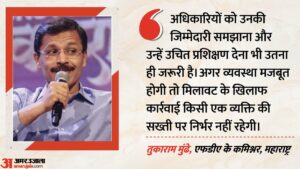
In 20 years of services, Mundhe has been transferred so often that reports say the number exceeds his years in service, though he declines to confirm it. “I have stopped counting my transfers,” he told the BBC. Admirers see the transfers as evidence of his uncompromising style.
Earlier, Mundhe has won praise for his handling the Covid pandemic outbreak, as Nagpur city’s municipal commissioner and earlier for his work on water conservation in Maharashtra’s drought-prone regions. “When he was transferred out of Nagpur, thousands showed up outside his home to bid him farewell. It took him an hour just to reach his car,” says Shafi Pathan, a journalist who’s written Mundhe’s biography in the local Marathi language.
**********
Which Is India’s Oldest Co-Educational Boarding School?

India is home to some of the world’s oldest and most prestigious boarding schools. But did you know that the country’s oldest co-educational boarding school was established nearly 180 years ago, near the hill station of Kasauli, Himachal Pradesh? The Lawrence School, Sanawar, established on April 15, 1847, is the oldest co-educational boarding school in India, and one of the oldest boarding schools in the world, perched at an altitude of around 1,750 meters (5,740 feet), the campus is surrounded by pine, deodar and oak forests.

The school was established by Sir Henry Lawrence and Lady Honoria Lawrence during British rule. It was originally founded for the children of British soldiers serving in India before evolving into one of the country’s leading residential schools. Unlike many old boarding schools that started as boys-only institutions, the Lawrence School, invited both boys and girls from its very first batch. The inaugural class had 14 students, seven boys and seven girls.
The picturesque campus spans more than 130 acres and features classrooms, boarding houses, sports grounds, forests and heritage buildings, offering students a peaceful environment to study and grow.

The school’s motto, “Never Give In,” reflects its emphasis on resilience, discipline and character-building. These values remain at the heart of the institution’s educational philosophy even today.
*******
Madhopati, a small village of 75 house has given 47 IAS & IPS offices to India, plus IRS, and IFS, and also to ISRO, BARC, the World Bank
Madhopatti, a sleepy village in Jaunpur district of eastern Uttar Pradesh, looks like hundreds of other rural hamlets with uneven roads, erratic electricity, a government school or two, and little else. There are no libraries, no coaching center, and no elite English-medium schools.

Yet, this unassuming place has made it to the national imagination for a reason: over the past century, from 75 house it has given 47 IAS & IPS offices to India, plus IRS, and IFS. Some families here have four siblings in the services; others have cousins and in-laws spread across the bureaucracy. This unique record has earned Madhopatti the nickname: India’s “IAS Factory.” While IAS and IPS officers have put Madhopatti on the map, its legacy extends further. Villagers have gone on to work with ISRO, BARC, the World Bank, and state information directorates. For a village of this size, that range of representation in elite institutions is unparalleled.
The story goes back to 1914, when Mohammad Mustafa Hussain cleared the civil services under British rule, becoming the village’s first officer. That single achievement sparked an aspirational chain reaction. By the 1950s, Madhopatti had its first IFS officer, Dr. Indu Prakash Singh, followed by a wave of others among them, Vinay Kumar Singh, Chatrapal Singh, Ajay Kumar Singh, and Shashikant Singh, all brothers who went on to occupy senior positions in administration. Over the decades, the village steadily added names to the list, creating not just officers, but a tradition of service that younger generations were almost expected to continue.
No Coaching Hubs, Just A Community Mentorship
Unlike Delhi’s Mukherjee Nagar or Prayagraj’s Civil Lines, Madhopatti has no coaching industry. Success here comes from a culture of peer mentoring.
• Seniors who clear the UPSC guide juniors with books, notes, and strategy.
• Aspirants often start preparing during intermediate college, combining local Hindi-medium schooling with self-study in English.
• Families play a central role: sibling study together, parents encourage attempts, and every success is celebrated across the village.
• As one local officer once put it, “Here, cracking the UPSC is like joining a family business except the business is public service.”

The Factory Without Any Factory
Today, young Madhopatti aspirants continue to aim for the UPSC, carrying forward a century-old legacy. They walk down the same dusty roads, study under the same dim bulbs, but with the knowledge that dozens before them have cracked India’s toughest exam without coaching, without privilege, and without excuses. In that sense, Madhopatti is not an “IAS Factory” in the conventional sense. It is, instead, a reminder that grit, tradition, and mentorship can be the most powerful infrastructure of all.
********







Add comment