

 Sahityika Admin
Two experiences in My Life
© Pratip Bhattacharya, 1986 Civil Engineering
Me and My Flat Partner: A Hilarious Haunting
[This is based upon my real experience.
Between 2016 and 2019, I was working at Jamshedpur and staying with a few colleagues in two adjacent flats.]
Once upon a midnight dreary, I found myself ensconced in my spartan flat, a veritable palace of minimalism that echoed with the ghosts of furniture past. I was certain of one thing: someone — or something was dragging a chair in our living space across the floor with all the grace of a drunken poltergeist. The unmistakable sound of wood scraping against tile sent shivers down my spine.
I glanced at my mobile phone, and it was well past midnight. Time flies when you’re being haunted! The cacophony continued, now with the added weight of a table being pushed — perhaps it was trying to escape the confines of our shared existence. My flat, a sprawling eighteen hundred square feet of eerie emptiness, housed three rooms, two and a half restrooms (because who needs all full one?), a store room, and a kitchen that could double as a horror movie set.
Tonight, I was alone in this vast expanse. My flatmates had yet to arrive in Jamshedpur, leaving me to fend for myself against whatever spectral forces lurked beyond my door. The attendant boy was snoring away in the adjacent flat – bless his slumbering soul -while I sat in my dimly lit room, convinced that I was the sole occupant of this haunted abode. Yet outside my door, chairs and tables were engaged in a raucous game of musical furniture.
My door was locked tight, and darkness enveloped me like a shroud. A flickering streetlamp cast ghostly shadows that danced across my sparse furnishings: one cot, a Neelkamal table and chair combo (the epitome of elegance), and my trusty suitcase filled with the week’s wardrobe essentials.
Suddenly, silence fell like a guillotine. Had I imagined it all? The sounds of furniture being rearranged? But then came another noise — a light-footed scurrying that could only belong to an impish child or perhaps an overzealous spirit practicing for the next ghostly marathon. My heart raced as I sat frozen in place, drenched in sweat despite the chill creeping into my bones.
After what felt like an eternity — though it was likely just a few minutes. I summoned every ounce of courage left in my quivering form and crept toward the door. With fingers trembling like leaves in a tempest, I unlocked it and peered outside into the abyss. Found the living room lay unchanged, as if mocking my fears. The chairs were precisely where they had been when I last closed my eyes. No running children or mischievous spirits; just an empty room staring back at me with an air of smugness. I slammed the door shut and locked it tighter than Fort Knox. Cocooned in my blanket, I closed my eyes and waited for more sounds to break the silence. But nothing came, and eventually, sleep claimed me.
Morning light streamed through the window like an unwelcome guest. I awoke with memories of last night’s spectral symphony still fresh in my mind. Summoning what little courage remained, I ventured out into the daylight, determined not to let any spooky nonsense get the better of me. I didn’t dare mention my frightful night to the attendant boy; who would believe such absurdity?
The day passed uneventfully until night fell once more. After dinner, as I settled back into my room, memories of last night crept back like an unwelcome shadow. Anxiety coiled around me as anticipation bubbled up within; sleep eluded me once again.
Then it happened — a sudden burst of running footsteps! My heart leapt into my throat as I braced myself for the inevitable sounds of furniture being dragged across the floor once more. This time, however, I was paralyzed by fear; wide-eyed and mummified on my bed, I could do nothing but listen as chaos unfolded outside. After what felt like hours of this nocturnal racket, silence returned. An oppressive stillness that engulfed me whole. Exhausted from fear yet again, sleep finally claimed me.
The morning sun greeted me once more with its cheerful rays, but something had shifted within me. No longer merely fearful, I became contemplative. What could possibly explain these nightly disturbances?
Inquiring minds want to know! A chat with the attendant boy over evening coffee revealed that the family residing above me had children notorious for their late-night antics — pranksters who delighted in creating chaos at all hours! Suddenly it dawned on me: with my flat’s minimal furnishings and those pesky service ducts connecting our apartments from roof to ground floor, it was entirely plausible that their mischief was echoing through empty space!
But should I verify this theory? What if it turned out to be something far more sinister? If proven wrong about these little rascals being responsible for my sleepless nights… well, let’s just say I’d rather not contemplate that possibility!
Thus, reconciled with this newfound explanation — my flat partner being nothing more than mischievous children above — I found solace in knowing that perhaps I wasn’t sharing my living space with a ghost after all… or maybe just a very lively one! And so began our strange coexistence: me and my flat partner—the prankster poltergeist who kept me on my toes while ensuring life was never dull!

*********
Epilogue
In the ever-evolving tapestry of human experience, moments of introspection often arise from the most mundane occurrences. This narrative serves as a testament to the profound lessons gleaned from everyday interactions — lessons that resonate with the core of our societal fabric. As we delve into the intricacies of marketing and economics through the lens of seemingly trivial events, we uncover insights that challenge conventional wisdom and provoke deeper contemplation.
Marketing Strategy
On a mid-week afternoon, I found myself navigating the bustling atmosphere of Tata Nagar station, en route to Kolkata for a seminar. I left from my office earlier than usual, arriving at the station around 4:45 PM, only to discover that my train was delayed. The announcement indicated it would arrive around 5:20 PM.
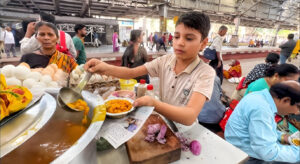
While waiting beside an IRCTC snacks stall, I noted the relatively sparse crowd at the station. A woman, tasked with relaying updates on train delays, was visibly frustrated by her role in disseminating unwelcome news. As I observed her, another wave of activities erupted from the snack stall — a table contraption emerged, laden with plastic boxes filled with biryani. My attempt to count them revealed more than a hundred packages ready for sale.
Then a much-delayed train from Assam going towards southern part of the country arrived. It would stop for about fifteen minutes. As the minutes passed, travelers began to trickle in, their fatigue evident from long journeys. The platform transformed into a hive of activity as people filled their water bottles and sought sustenance. Surprisingly, despite the abundance of biryani packets priced at seventy rupees each, initial sales were sluggish. However, as time wore on and the platform swelled with hungry patrons, demand surged.
Within a mere ten minutes, nearly all egg biryani was sold out. The stall’s offerings shifted to vegetarian biryani at forty rupees, which also vanished quickly. The vendor’s adeptness in managing supply and demand was astonishing; by the end of this brief interlude, he had amassed nearly ten thousand rupees in revenue. Strategy to sell costlier item first and bringing out cheaper option at fag end actually was resoundingly successful. Then the train left for its destination ahead.
As my train approached and the whistle blew, I felt a familiar joy at witnessing its departure — a reminder of journeys yet to unfold. Meanwhile, I observed a young boy diligently collecting discarded plastic packets strewn along the tracks. His mother joined him in this endeavor, and together they amassed two bulging sacks for recycling.
The scene was further animated by three dogs scavenging for remnants left behind by travelers. Just as I began to reflect on this cycle of consumption and waste management, a Swachh Bharat cleaning team arrived, methodically collecting trash along the platform.
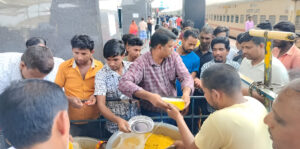
This vivid tableau presented itself as an invaluable learning experience — one that highlighted an intricate interplay of roles within our society. Each participant in this microcosm — from vendors to scavengers — performed their tasks with an unspoken understanding of purpose and timing. It became evident that even in chaos, there exists a method controlled by an invisible hand.
Economics
Later that same week, as I settled into an Ola cab for my journey back to my flat in Jamshedpur after work, I found myself buoyed by recent news: two Bengalis had achieved remarkable milestones—Sourav Ganguly was set to become BCCI President while Abhijit Banerjee won the Nobel Prize in Economics. Despite battling a chronic cold, my spirits soared at these accomplishments that reignited hope for our beleaguered state.
However, my driver’s demeanor contrasted sharply with my elation; he expressed frustration over his earnings after spending seven minutes driving to pick me up for a mere ten-minute ride. His grievances revealed a troubling reality: Ola’s commission structure left him struggling to sustain himself and his vehicle.
As our conversation unfolded, he articulated his discontent with how Ola dictated pricing — a model he deemed foreign and incompatible with Indian sensibilities. He posed a thought-provoking question: “Have you ever encountered an Indian economic model?” This inquiry struck me deeply; it underscored how many contemporary business frameworks are rooted in Western ideologies rather than indigenous practices.
He lamented that money should circulate freely among individuals rather than accumulate in the hands of a few — a principle reflected in traditional Indian practices like Dhanteras, which encourages spending and economic activity rather than hoarding wealth. His insights resonated profoundly; they illuminated how consumer behavior is shaped by cultural imperatives.
As we continued our journey through Jamshedpur’s streets, he articulated concerns about India being perceived merely as a vast market rather than a nation with unique socio-economic dynamics. He argued that true economic growth hinges on fostering confidence among citizens so they may spend without fear of future uncertainties.
His critiques extended to India’s education system — a remnant of colonial influence that he believed stifled authentic Indian identity and economic understanding. Despite initial assumptions about his political leanings, I found his perspective refreshing; it transcended mere ideology and delved into genuine concern for societal well-being.
Upon reaching my destination, I expressed gratitude for his enlightening discourse; it had challenged my preconceived notions about economics and identity in contemporary India.
Prologue
In reflecting upon these experiences — both at Tata Nagar station and during my cab ride — I recognize that life is replete with lessons waiting to be uncovered amidst daily routines. Through attentive observation and open dialogue, we can glean insights not only about marketing strategies or economic models but also about our collective human experience. This narrative serves as an invitation to engage deeply with our surroundings and embrace the wisdom inherent in every interaction we encounter along life’s journey.
*******






Add comment